04
Copper peptide hair growth and the GHK-Cu question
The strongest human hair-count result here came from a mixture containing GHK. The way its two strengths performed is more interesting than the usual claim of regrowth.
The combination trial
The 6-month randomized trial in 45 men with androgenetic alopecia tested a complex of 5-aminolevulinic acid and GHK. Androgenetic alopecia is the inherited pattern of hair loss often called male-pattern baldness. The preparation contained both ingredients.
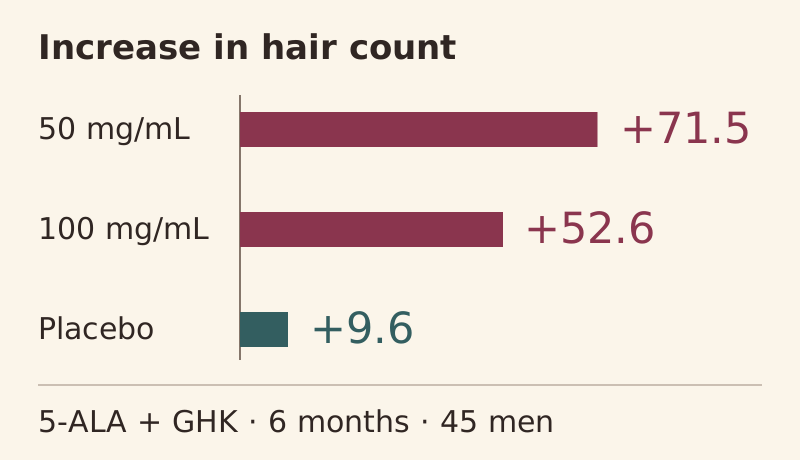
Hair counts increased by 71.5 with 50 mg/mL, by 52.6 with 100 mg/mL and by 9.6 with placebo. No adverse events were reported in any group. The concentrations describe the study mixture. They are included here to identify the comparison, without supplying an amount for personal use.
The weaker mixture produced the larger hair-count gain. That reversal amuses the skeptic in me: it makes the easy assumption that more must work better difficult to sustain. With a small trial, though, a difference between tested strengths needs replication before it can carry a larger argument.
Which peptide was tested?
The human trial supports further investigation of the particular combination. Assigning its whole effect to GHK-Cu alone would change the identity of the tested preparation. That substitution is precisely where many broad copper peptide hair growth claims become unconvincing to me.
There is another easily confused paper: the experiment on removed human hair follicles used AHK-Cu. Those follicles elongated, and supporting dermal papilla cells responded in culture. AHK-Cu differs from GHK-Cu in an amino acid. Human tissue outside the body also leaves the clinical hair-loss question open.
The earlier copper-peptide hair-follicle work in C3H mice supplies animal evidence. Each of these experiments has a useful place: a combination trial in men, another peptide on removed follicles, and copper complexes in mice. Their names and settings deserve to survive the journey into a headline.
Growth mechanisms and regrowth timing
The tissue-remodeling research describes support for repair cells and blood-vessel growth. Those mechanisms offer possibilities around an actively growing follicle. GHK-Cu is not characterized in that literature as a DHT blocker; DHT is the hormone implicated in follicle shrinkage in male-pattern hair loss.
The controlled human observation lasted 6 months and concerned the combination. It leaves no established timetable for hair regrowth with GHK-Cu alone. Reports of less shedding on forums are anecdotal accounts, not clinical evidence, and often involve other approaches at the same time.
A trial that separates the combination's ingredients would resolve the question of attribution that remains so frustrating here. Until then, the hair-count result earns interest for the formulation actually tested. The skin research has a different and somewhat broader human history.